The travel makeup market has grown beyond a niche segment into a mainstream category that influences packaging design decisions across the beauty industry. Within this space, the foldable cushion compact case has emerged as a standout form factor, combining portability, product protection, and user convenience in a way that traditional compacts struggle to match. For beauty brands planning travel-focused product lines or evaluating packaging options for on-the-go consumers, understanding the specific design features that give foldable cushion compact cases their market advantage is both a creative and procurement consideration.
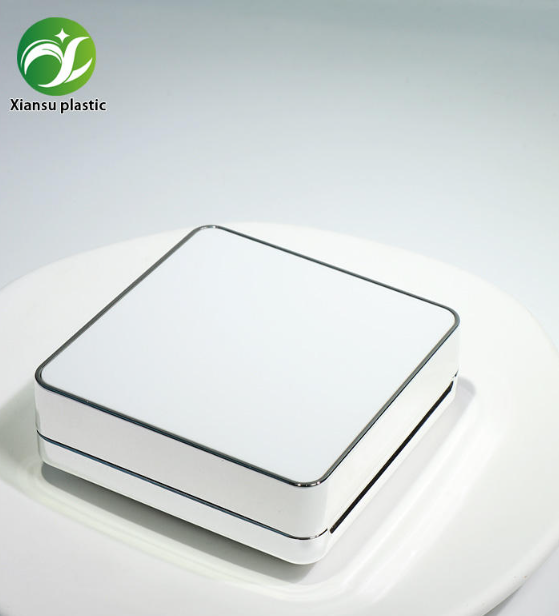
The defining characteristic of a foldable cushion compact case is its ability to collapse into a slim profile without sacrificing internal product capacity. Unlike traditional fixed-structure compacts where the lid and base maintain a constant angle, foldable designs use a hinge mechanism that allows the compact to close flat, reducing the overall thickness when not in use. A square magnetic cushion compact case with dimensions around 75.4mm by 22.9mm represents the balance that successful travel packaging strikes: wide enough to accommodate a usable cushion sponge and puff compartment, yet thin enough to slip into a small handbag, clutch, or travel pouch. The square form factor further enhances packing efficiency because rectangular shapes tessellate more efficiently in luggage than round compacts.
For travel products, the worst-case scenario is opening a makeup bag to find that a compact has sprung open during transit, leaking foundation onto clothing, electronics, or other cosmetics. This is where magnetic closure systems provide a decisive advantage over traditional snap-fit mechanisms. A magnetic cushion compact case uses embedded magnets that pull the lid and base together with consistent, calibrated force. Unlike friction-based snap closures that can weaken with wear or release when jostled at certain angles, magnetic systems maintain their holding force indefinitely and are less susceptible to accidental opening from vibration or impact during travel. The magnetic mechanism also provides satisfying tactile feedback when closing, giving the user confidence that the product is securely sealed.
A key advantage of well-designed cushion compact cases is that they consolidate multiple travel items into a single compact unit. The inclusion of a built-in mirror inside the lid eliminates the need to carry a separate compact mirror for touch-ups, while a dedicated puff compartment keeps the application tool clean and accessible without requiring an external pouch. The puff layer in advanced designs is separated from the cushion sponge by a divider that prevents product transfer and keeps the puff surface dry. For the traveler working with limited luggage space, this consolidation means one compact case replaces three separate items: foundation bottle, mirror, and applicator.
Travel conditions subject packaging to stresses that daily home use rarely imposes: temperature fluctuations from cabin pressure changes to tropical humidity, impact from luggage handling, and repeated open-close cycles in varied environments. ABS plastic has become the material of choice for travel-friendly cushion compact cases because it offers an optimal combination of properties for these demands. Its impact resistance protects the internal cushion and mirror from drops and knocks. Its dimensional stability means the hinge alignment and magnetic closure positioning remain consistent across temperature ranges encountered during travel. Its smooth surface accepts electroplated and matte finishes that resist scratching from contact with keys, jewelry, and other bag contents.
Travel cosmetics occupy an interesting psychological space: consumers often prefer travel-sized or portable products, but they do not want those products to feel cheap or disposable. An electroplated finish on a cushion compact case addresses this by delivering a metallic luster and smooth tactile quality that elevates the perceived value of the product. The reflective surface also performs well in the varied lighting conditions that travelers encounter, from dim airplane cabins to bright hotel bathrooms, where a mirrored or metallic lid helps the user locate the product quickly in a bag. For beauty brands targeting the premium travel segment, the combination of a foldable square structure with electroplated finishing creates a product that feels considered and intentional.
A beauty brand selling cushion foundation in the Southeast Asian market noticed that customer reviews frequently mentioned foundation leakage inside makeup bags during travel. The existing packaging used a round snap-fit compact that would pop open when subjected to the pressure and movement of a packed bag. The brand transitioned the product to a square magnetic cushion compact case with a foldable design and magnetic closure system. The square shape distributed internal pressure more evenly than the round design, reducing the tendency for the lid to warp. The magnetic closure provided consistent sealing force that snap-fit mechanisms could not match after repeated use. Post-transition, the brand's customer service data showed a 40 percent reduction in leakage-related complaints, and product ratings on major e-commerce platforms improved by an average of 0.6 stars. The per-unit cost increase from the magnetic closure was approximately eight cents, which was absorbed by reduced return shipping and replacement product costs within the first quarter.
Q: Does a magnetic closure on a cushion compact case actually prevent leakage, or is it just a premium feature?
A: Magnetic closure provides real functional benefits for leakage prevention, not just aesthetic appeal. The consistent, calibrated force of magnetic closing maintains a uniform seal around the compact's perimeter, particularly important for cushion products containing liquid foundation. Snap-fit closures can develop uneven wear patterns that create gaps, while magnetic systems maintain their sealing integrity over thousands of use cycles.
Q: Are foldable cushion compact cases heavier than traditional compacts, making them less suitable for travel?
A: The weight difference is typically negligible and often offset by the consolidation advantage. A standard square magnetic cushion compact case made of ABS weighs approximately 40g to 45g, comparable to many non-foldable compacts. More importantly, because a well-designed cushion compact integrates the mirror, puff, and product, the traveler carries one unit instead of three separate items.
Q: What should I look for in a cushion compact case supplier to ensure travel-ready quality?
A: Request quality testing documentation for three specific areas: hinge cycle testing for durability, magnetic strength testing for consistent closure force across batches, and drop testing or vibration testing that simulates travel conditions. A supplier with documented in-process quality control at each production stage is better positioned to deliver consistent travel-ready packaging.
COMPARISON TABLE
|
Feature |
Traditional Snap-Fit |
Foldable Magnetic |
|
Closure Reliability |
Decreases with wear |
Consistent force; vibration-resistant |
|
Travel Leakage Risk |
Moderate to High |
Low - uniform seal |
|
Portability |
Variable; round wastes space |
Square; slim foldable design |
|
Integrated Features |
Basic - often mirror only |
Mirror, puff, divider |
|
Per-Unit Cost |
Lower - fewer components |
Moderate - magnets add ~8 cents |


 EN
EN