
 EN
EN



Why Recyclable Cosmetic Jars Wholesale Cater to Eco Conscious Consumers
The global cosmetic packaging market was valued at over USD 57 billion in 2025 and continues to expand. Yet only 9% of all plastic packaging actually gets recycled, according to the British Beauty Council. For beauty brands sourcing cosmetic jars wholesale, that gap is no longer just an environmental footnote. It has become a buying signal that eco-conscious consumers track closely, and increasingly act on.
Have you ever noticed how quickly "eco-friendly" claims on packaging have multiplied, while the percentage of packaging that is genuinely recyclable has stayed stubbornly low? Understanding the difference is exactly where wholesale buyers can build a meaningful competitive edge.
Who Are Eco-Conscious Beauty Consumers?
Eco-conscious consumers are not a niche edge case. Research from NielsenIQ and Fortune Business Insights consistently shows that sustainable packaging ranks among the top purchase-influencing factors for beauty buyers in North America and Europe — markets where cosmetic packaging demand reached USD 14.92 billion and USD 13.05 billion respectively in 2025.
These consumers share three defining behaviors when they evaluate beauty purchases:
- They research packaging materials before committing to a brand, particularly looking for Post-Consumer Recycled (PCR) content declarations.
- They distinguish between packaging that claims to be recyclable and packaging that is designed for actual end-of-life recyclability — a distinction that carries real weight.
- They factor packaging choices into brand loyalty: brands that visibly invest in sustainable packaging structures tend to see stronger repeat purchase rates among this segment.
What this means for wholesale sourcing decisions is fairly direct: cosmetic jars wholesale that incorporate genuine recyclable design — PCR resins, mono-material construction, or clearly labeled recycling streams — deliver a product story that conventional packaging cannot match with this audience.
What Makes a Cosmetic Jar Genuinely Recyclable?
The distinction matters here, because "recyclable" on a label and "recyclable in practice" are often two different things. According to the 2024 Cosmetics Packaging Report, 64.5% of all cosmetic packaging uses plastic — yet most of it is not effectively recovered. The problem is not typically the material itself; it is the combination of materials, colorants, and construction choices that make sorting and processing economically unviable.
Provided that a jar meets the following criteria, it has a credible claim to recyclability:
- Mono-material construction: Jars made from a single polymer type (PP or PET, for example) are far more compatible with existing municipal recycling infrastructure than multi-layer or mixed-material designs.
- PCR content: Post-Consumer Recycled resin uses plastic that has already been collected, sorted, and reprocessed. Jars with certified PCR content close the loop in a verifiable way.
- Absence of problematic additives: Metallic coatings, embedded glitter, or UV-reactive pigments can contaminate recycling streams even when the base resin is recyclable. Clean matte or satin finishes are more compatible.
- Separation-friendly assembly: Lids, liners, and inserts that can be separated without tools make it realistic for consumers to actually recycle each component.
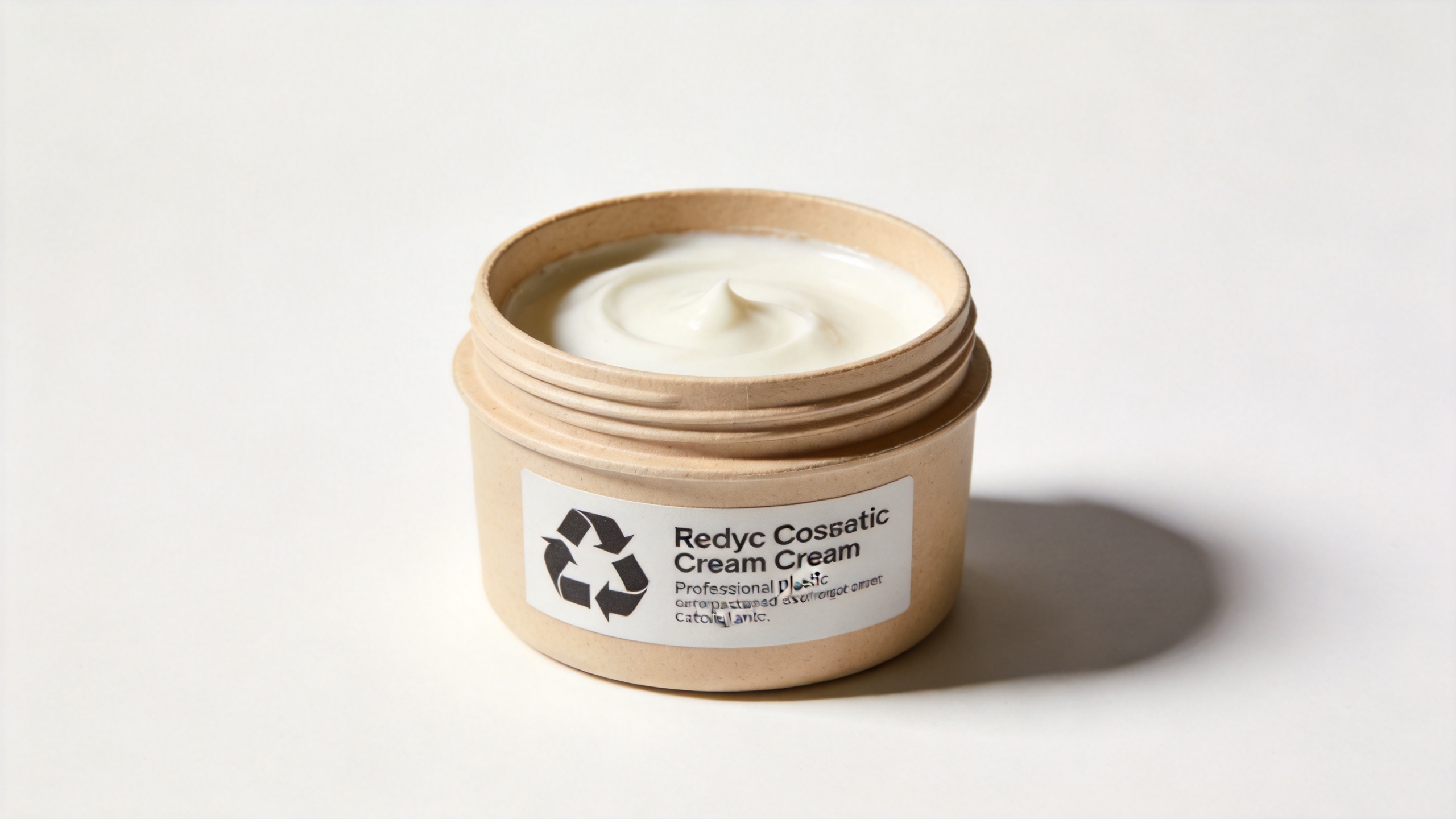
In practice, a recyclable jar that ticks all four criteria is not dramatically more expensive than a conventional alternative — but the price-to-story ratio shifts considerably. The eco premium, where it exists, is often recovered through reduced customer acquisition cost and stronger brand advocacy among sustainability-minded buyers.
Why Wholesale Volume Amplifies the Eco Impact — and the Business Case
For brands sourcing cosmetic jars wholesale, scale cuts both ways. Ordering in bulk from a supplier without genuine recyclable options locks the brand into materials that face increasing regulatory scrutiny — particularly in the EU, where PCR adoption in cosmetics packaging is accelerating alongside regulations targeting single-use plastics and non-recyclable formats.
Sourcing recyclable cosmetic jars wholesale at meaningful volume gives brands several practical advantages:
- Cost normalization: PCR resin costs have converged closer to virgin plastic pricing as supply chains mature. At wholesale volumes, the per-unit premium is often under 5–10% compared to standard packaging — a tradeoff that pays back quickly in brand positioning value.
- Regulatory positioning: European markets are tightening packaging compliance requirements. Brands already sourcing PCR-compatible cosmetic jars wholesale are ahead of mandates rather than scrambling to reformulate their packaging supply chain.
- Supplier documentation: Reputable wholesale manufacturers can provide sustainable material ingredient declarations that support outward eco claims — a critical requirement for brands making environmental marketing statements in regulated markets.
- Refill-ready design options: An emerging segment of eco-conscious consumers actively seeks refillable packaging, particularly in skincare and facial cream categories. Wholesale suppliers offering refill-compatible jar structures allow brands to serve this segment without redesigning from scratch.
How to Evaluate Recyclability When Sourcing in Bulk
Not all "eco" claims in wholesale catalogs are equally substantiated. When evaluating cosmetic jars wholesale for recyclability credentials, a practical checklist helps cut through the noise:
- Ask for material data sheets that confirm resin type, PCR percentage, and certification (e.g., ISO 14021, UL Environment ECVP, or equivalent).
- Request a separability diagram for multi-component jars — lid, body, liner, applicator — to confirm each part can be sorted independently.
- Check whether the supplier's colorant and surface treatment options have been tested for recycling stream compatibility.
- Verify that the supplier can issue a material sustainability declaration that supports your brand's environmental marketing communications.
Under the right conditions — a supplier who maintains transparent documentation and can support varying order volumes — switching to recyclable formats for wholesale cosmetic jars does not require a complete packaging overhaul. Many brands start by converting their highest-volume SKUs first and expand from there as customer response validates the investment.
The Alignment Between Recyclable Packaging and Eco-Conscious Purchase Behavior
The cosmetic packaging market is projected to reach USD 89.72 billion by 2034 (Fortune Business Insights). Within that growth, brands that have aligned their cosmetic jars wholesale sourcing with genuine recyclability are positioned to grow faster than the market average — because eco-conscious consumers are not a segment that is fading.
They are expanding. And they are increasingly discerning: they recognize the difference between a recyclable label on a non-recyclable laminated jar and a mono-material PCR jar with a verifiable recycling story. Wholesale buyers who understand that distinction and source accordingly are not just meeting a consumer preference — they are building a supply chain that fits the regulatory and market environment taking shape over the next decade.
For brands ready to make that shift, the starting point is finding a wholesale supplier who treats sustainability documentation as part of the product, not an afterthought, and can support that conversation at the volume your business requires.

